

Welcome to Talking Tuesday!
At Humanoids, great design starts with understanding people, not just screens. We spoke with Joshua, our UX Design Lead, about what drives his work, how he approaches complex projects, and why putting the user first is the only approach that truly delivers results.
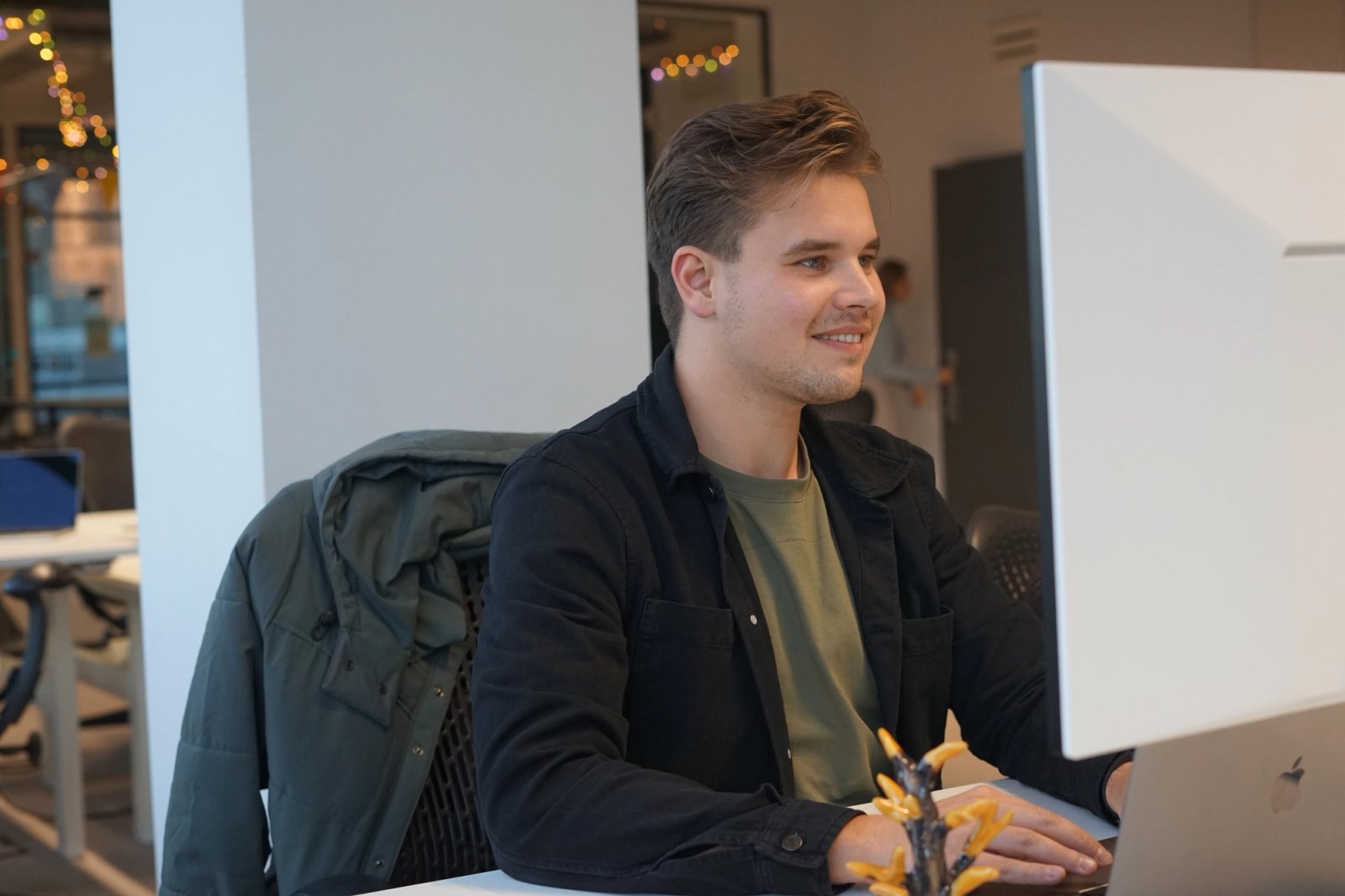
This week with Joshua: UX Design Lead
What project are you working on right now?
I'm currently working at Rabobank in the Enterprise UX team, within an environment focused on adherence across the bank. I'm working on tooling to monitor, manage and improve applications on the topic of security. Among other things, I'm working on a task list for engineers to check whether their applications are up-to-date and secure.
What do you find most interesting about it?
What I find interesting is that the process was mainly analogue and offline before (think forms and catalogues) and we're now making the transition to digital and uniform ways of working. It's complex work, so it's easy to get lost in the content and processes at first. But it feels really great when it all 'clicks' and you fully understand everything, which means you can properly support your teams.
What do you bring to a team?
As a designer embedded in DevOps teams made up of developers, I primarily add usability to the applications. I work alongside developers who are incredibly good at building things, but my job is to represent and advocate for the user, to make sure the product is actually pleasant and intuitive to use.
What tip would you give to someone just starting out?
Stay open to learning from others and don't think you have all the answers, because both experienced professionals and newcomers can bring the very best insights. Since it's a field that's constantly evolving, starters are often more up to date on the latest trends and patterns than a designer with years of experience. It's also important to be visible and make yourself a point of contact in your work environment, so people always know where to find you when they have questions.
What's your favourite tool or design hack you can't live without?
I'm a big fan of NotebookLM for research. It's a Google tool that lets you upload a wide range of information including audio recordings, video footage, and text documents, which you can then query yourself, kind of like ChatGPT. I mainly use it to summarise recordings of meetings and interviews and quickly extract the key learnings. An absolute must for UX'ers who want to gather insights quickly, just always check whether it's permitted within your project since there is an LLM behind it. A second tool I use a lot is the autofill option in Figma. When I'm designing a table, I make sure the dummy data I use reflects reality as closely as possible. That way I avoid surprises later in the process and it becomes much easier to test your mock-ups with real users to get the best insights. For me, good design always starts with honest assumptions.
Can you tell us about your growth as a specialist over the past few years?
I've learned an enormous amount at Humanoids. I'd only been out of university for six months when I started here as a UX'er in 2023. I have a Master's in Design and a Bachelor's in Marketing, a more than solid foundation for our field. But I still started my career with a kind of imposter syndrome, surrounded by all the talent at Humanoids. Being thrown in at the deep end on projects taught me a huge amount, which is how I recently became Design Lead. Now I genuinely love coaching and guiding people who are starting out just like I once did.
What was your biggest challenge on a project and how did you overcome it?
My biggest challenge was a project where I was doing research with a very specific target group: people with learning difficulties and older adults. Traditional digital testing methods simply didn't work for this group, because they were often too complex or modern in their setup. So I chose to completely redesign the research approach. By implementing additional measurement points, the research became accessible to everyone. I found this project a real eye-opener that pushed me to think far beyond standard UX practices.
What do you love most about this industry?
What I love about UX design is that usability comes first and the visual side comes second. I enjoy making choices that might not win any beauty contests but represent a huge win for the user, especially with specific target groups. In my view, that's a bigger achievement than a pretty picture.
How do you see the future of your role?
I've seen a major focus on AI tooling in tech over the past few years, but I don't believe it will ever fully take over my work. I see AI as a tool, not a direct replacement. I don't think machine learning is yet capable of truly understanding and advocating for the user's needs the way a human can.
Which organisation would you most like to work with in the future?
I'd love to work at a social organisation someday, think healthcare or education. Something on a smaller scale where I can make a more direct, tangible positive impact on the world, as opposed to the semi-public sector organisations where I've built up some great experience so far.
What makes Humanoids special?
What makes Humanoids special is that they consistently hire incredibly talented people who might come to market as juniors but are far better than other designers I come across. And on top of that, they're genuinely great people to be around. I'm incredibly proud that I now officially have the role of Design Lead, coaching and guiding people through this journey. I truly believe our Humanoids can make a difference in any organisation and are able to get to grips with complex subject matter really well.
Joshua's story reflects what we at Humanoids believe: that the best designs are created when you truly understand who you're designing for. Not just the screens, but the people behind them. Curious about what that approach could mean for your project? We'd love to tell you more.