

Technology makes it easier to build products. But whether people actually understand and want to use those products is a different story.
More digital products are being built right now than ever before. AI tools make it possible to launch a working prototype in a matter of days. What used to take months and an entire development team can now be done by one person. The technical barrier to building something has never been lower.
That sounds like good news. And for many things, it is. But there's a downside that doesn't get talked about enough.
When building becomes easier, the market fills up. More products, more competition, more noise. And once everyone can launch, it's no longer about who gets something live the fastest. It's about who builds a product that people actually understand, trust, and keep using.
That's exactly where UX comes in. And the irony is that the AI era doesn't make that field obsolete, it makes it indispensable.
Everyone can build now. But not everyone designs for the user.
Gartner predicted back in 2021 that 80% of digital products in 2024 would be built by people without a traditional technical background. Not developers, but domain experts, entrepreneurs and marketers putting together products themselves using low-code and AI tools. That prediction has become reality, and with the rise of AI tools, the trend is only accelerating. The barrier between an idea and a working application has almost disappeared.
That shift has consequences. Far more products are entering the market. Products that work perfectly well technically, but where the question "how will a user actually get through this?" was never asked. Where someone thought about the database, but not the error message. About the functionality, but not about the first time someone opens the product and has no idea what to do.
Building and designing for people are two very different things. AI accelerates the first enormously. The second still requires human insight: understanding how people think, what makes them drop off, what builds trust and what causes frustration.
That gap grows larger the more gets built.
What UX challenges do AI products introduce?
It's not just about more products. AI products also bring an entirely new kind of usability problem, something we rarely encountered with traditional software.
Traditional software does what you tell it to. You click a button, something predictable happens. AI systems work differently. They respond to context, learn from behaviour and give answers that aren't always the same. That's their strength, but also the challenge. Because users are accustomed to systems that behave predictably.
In practice, we see a number of recurring UX problems with AI products:
Users don't know what the system can and can't do. When an AI tool sometimes gives excellent answers and sometimes gets things completely wrong, users no longer know what to expect. That undermines trust. Clearly communicating the boundaries of a system is a design question, not a technical one.
AI output can be hard to interpret. AI rarely gives an answer with 100% certainty. How do you display uncertainty in a way that helps people rather than confuses them? When do users still trust the output, and when don't they? These are questions you can only answer by testing with real users.
Complex functionality needs to feel simple. Under the hood of an AI system, something is happening that most people don't understand at all. It needs to feel like it just works. And that's exactly what good UX does: hide complexity, so people can reach their goal without needing to understand how the system actually works.
People want to stay in control. As AI takes over more tasks, users increasingly feel they're losing control. That's not just a feeling, it's a real risk once a system makes autonomous decisions that affect someone's work or life. Good AI UX gives people insight and control at the right moments, without overwhelming them with information.
These aren't problems you solve with better code. They require research, testing with real users, and design.
Is demand for UX designers really growing? The numbers
If you're wondering whether this is a temporary trend or something structural, look at the job market.
The US Bureau of Labor Statistics predicts that employment for digital designers and UX specialists will grow by 7% between 2024 and 2034, well above the 3% average across all occupations. The World Economic Forum placed UI/UX design at number 8 in its Future of Jobs Report 2025, ranking it among the fastest-growing professions worldwide through 2030.
The direction is clear: demand is growing especially for designers who can not only use AI, but also design intuitive experiences around it. That kind of talent doesn't appear on its own. That's why we've revamped our traineeship, with a stronger focus on designing both for and with AI.
How AI is changing the way organisations innovate
There's another development that's increasing the importance of UX, and it's less visible: the way companies and teams innovate is changing fundamentally.
For twenty years, the Double Diamond model was the standard in design and innovation. A structured method where you first diverge, gathering as many problems and insights as possible, then converge towards a solution. Useful, proven, and entirely logical for its time.
But that model was built for a world of post-its and limited data. Spending weeks conducting user interviews and manually analysing patterns in a small team comparing a handful of ideas. That was the bottleneck back then: people's processing capacity.
That bottleneck no longer exists. The Board of Innovation describes how AI tools now enable teams to explore dozens of problems and solution directions simultaneously, in a fraction of the time. What used to take a month can now be done in days. What used to be ten interviews can now be a hundred simulated user scenarios.
That sounds like an enormous efficiency gain. And it is. But there's a catch.
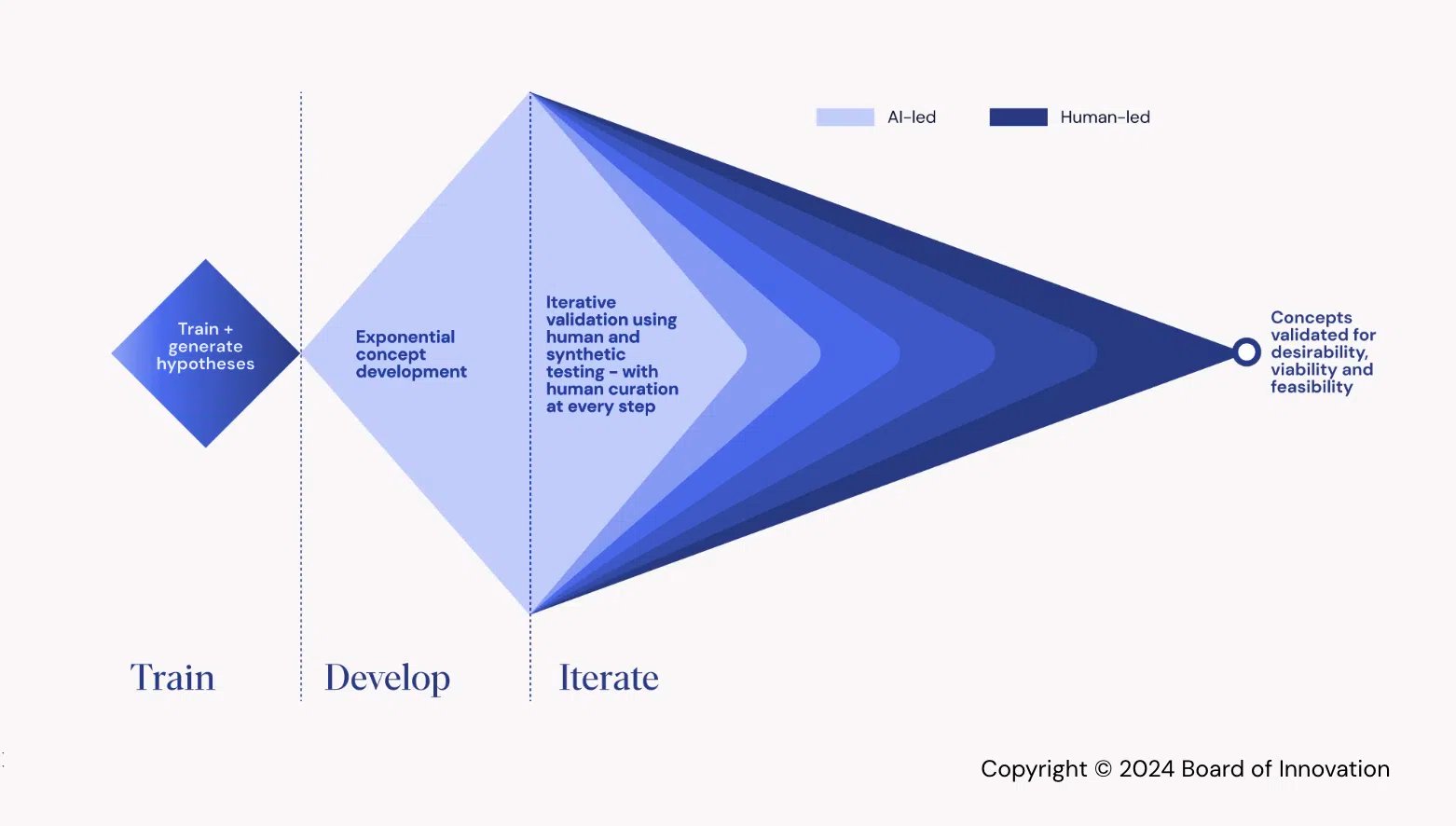
As AI takes over idea generation and data synthesis, the human role in evaluating that output becomes more important than ever. Who decides which of those hundred ideas is worth pursuing? Who checks whether a solution actually fits how real users think and work? Who ensures that no assumptions are made that sound logical but don't hold up in practice?
That's not something AI does. That's what UX researchers and UX designers do. The speed of AI actually increases the need for people who safeguard the human side of the story, and the same applies to the phase organisations often forget: adoption.
The part organisations often overlook: adoption
Technology doesn't implement itself. A tool can be theoretically perfect, but if people don't understand why they should use it, or if it doesn't fit how they work, that tool disappears after a few weeks. That sounds obvious, but that's exactly the thinking that often gets skipped.
Adoption, workflows, trust, decision-making and governance around AI output are all people-centred challenges. They require an understanding of behaviour, of how teams function, and of where resistance comes from and how to remove it.
This is precisely the territory where UX expertise comes in. Not just in designing the end product, but throughout the entire journey around it. How do you introduce a new system? How do you build people's trust in it? How do you design the interaction so it fits existing workflows?
Organisations that think about this early are significantly more likely to see a real return on their AI investment.
What does this mean for your product or organisation?
If you have a digital product, or are in the process of building one, you're probably already thinking about the technology behind it. Which AI tools do you use? How do you scale? What does it cost? There are so many tools available now that just making that choice is difficult.
A question that often gets skipped is how a new user will navigate through your product for the first time. Where do they get stuck? What don't they understand? What makes them come back, or not?
You don't answer those questions with assumptions. You answer them by testing. By observing real users. By seeing where things go wrong and fixing it before you launch at scale.
That's what usability testing does. And what UX audits uncover. User tests and audits should be part of how you build a product that people actually want to use.
More products, greater need for good experiences
AI means more products are being built. That's certain. But more products also means more competition, and in a market full of alternatives, it's rarely the technology that sets a product apart.
It's the experience.
A user who opens your product for the first time decides within thirty seconds whether it feels like it was made for them. If it doesn't feel right, doesn't feel intuitive, or raises too many questions, they're gone. Not because the product doesn't work, but because it doesn't feel like it works.
That's the space where UX makes the difference. And as more products are built, that space keeps growing.
At Humanoids, we help companies fill that space well. With usability testing, UX audits and user research. Not to produce nice-looking reports, but to make sure your product works for the people it's meant for.
Want to know what that could mean for your product? Feel free to get in touch.